The growing security threats facing Europe have renewed the debate over a common European defence architecture and how it should be financed. Since defence is a European public good, there are strong economic arguments for financing it at the supranational level. However, existing EU instruments remain fragmented and are neither designed nor sufficiently equipped to support a comprehensive European defence architecture. This article compares national borrowing, structured sovereign bond products, EU bonds, Eurobonds and a dedicated special purpose vehicle. It argues that a special purpose vehicle offers the most promising balance between collective financing and political feasibility, while performing best in terms of efficiency, fiscal risks and governance. By issuing earmarked defence bonds exclusively for joint European projects and combining them with strict governance rules, additionality requirements and safeguards against fiscal substitution, a defence special purpose vehicle could strengthen Europe’s defence capabilities while avoiding many of the political and fiscal concerns traditionally associated with Eurobonds.
The debate on financing European defence through common debt instruments has gained renewed momentum. In response to the growing spectrum of threats on Europe’s eastern flank, most EU member states have already increased their national defence expenditures. Yet, decades of chronic underinvestment mean that it will take considerable time to close the capability gaps that persist across key areas – from ammunition stockpiles to precision-strike systems and advanced technologies. From a macroeconomic perspective, the introduction of common borrowing for defence purposes would not only test the fiscal integration capacity of the European Union but could also redefine the balance between national sovereignty and collective security provision within the EU’s economic governance framework.
However, the question is how to finance joint defence spending. There are three options to finance the increased need for more defence spending: taxes, budget reallocations and debt. Marzian and Trebesch (2025), collecting data from 22 countries over 150 years, find that budget cuts did not play a major role in financing higher defence expenditures; almost all rearmament was financed in the short term through deficits and higher tax revenues. The authors propose that, in line with economic theory, Europe should finance the increased defence spending in the short term through debt, while in the medium term it should raise taxes and cut subsidies and social spending. This article asks what options exist for financing joint defence spending at the EU level via debt, assesses how these options should be evaluated and proposes a new solution.
The case for financing European defence
There are economic arguments for pooling defence tasks at the EU level: first, common defence as a response to an imminent threat to European security can be considered a European public good (see, e.g. Steinbach & Wolff, 2024). Defence, as a public good, is non-excludable and (almost) non-rivalrous: all citizens of the EU benefit from the deterrent and protective effect of European defence. Therefore, EU-wide financing instruments may be necessary to avoid underinvestment and free riding. Moreover, there are spillovers: stronger defence capabilities of a country or alliance can promote regional stability, which supports trade, investment and growth in neighbouring states; and defence cooperation in the EU may spread knowledge and capabilities across industries. From the viewpoint of fiscal federalism, defence is one of the (supra-)national public goods that provide services to the entire population of the entire region and therefore should be provided by a centralised institution (Oates, 1999). Moreover, coordination mechanisms could ensure that national defence spending is complementary rather than redundant.
From both a military and an economic standpoint, the establishment of joint European armed forces – probably in addition to national forces – appears to be a rational and efficient alternative to maintaining fragmented national armies only. Economies of scale in procurement, training and logistics would significantly reduce duplication and enhance interoperability. Nevertheless, different geoeconomic and geopolitical necessities as well as different preferences concerning size and structure (professional army vs conscript army) of armed forces may make European forces a common overarching protection shield.
Proponents of common European defence expenditures see three main advantages to a joint European defence policy (Scazzieri & Tordoir, 2024):
- It would increase overall European defence spending and enhance European defence research and production as well as joint procurement;
- Pooling could make investments in defence more efficient, thereby generating economies of scale. At the moment, Europe’s defence industrial base is rather fragmented and largely organised along national lines, which leaves little room for using economies of scale;
- Common investment in defence would reduce free riding by some member states that are reluctant to increase defence investment.
European defence financing options
At present, the European Union employs a range of instruments to foster joint military research and defence cooperation, such as the European Defence Fund (EDF), the Act in Support of Ammunition Production (ASAP), the European Defence Industry Programme (EDIP), the European Defence Industry Reinforcement Through Common Procurement Act (EDIRPA), the European Peace Facility (EPF) and the Connecting Europe Facility (CEF). Given the state of European defence and the growing spectrum of threats, these instruments are too limited, fragmented and politically difficult to scale up. Currently, all instruments used by the EU as a means of financing European defence expenditures cannot be seen as common European debt or defence Eurobonds as they lack the most important features of such instruments: joint issuance and joint liability. What other options are there?
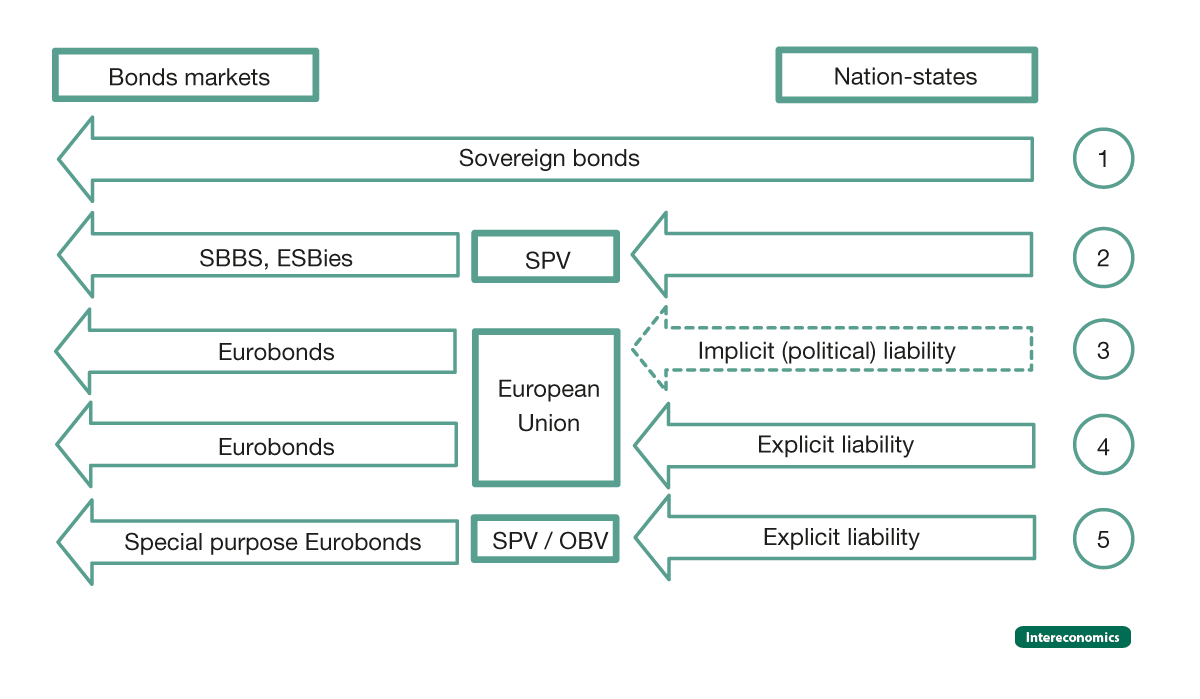
Given the recent developments, several proposals to jointly finance collective defence projects and the European defence industry have been made. Figure 1 gives an overview of different possibilities for financing European defence spending by means of debt.
Figure 1
Models of sovereign and common debt

Notes: ESBies: European Safe Bonds, OBV: off-budget vehicle, SBBS: sovereign bond-backed securities, SPV: special purpose vehicle.
Source: Author’s elaboration.
The first line in Figure 1 shows sovereign debt: a country issues its own debt on the bond market and has full liability as well as complete freedom of choice regarding scope and duration of the bonds. In its White Paper on European Defence Readiness 2030, the EU proposes to activate the national escape clause of the Stability and Growth Pact, thereby allowing member states to increase defence spending (European Commission, 2025). The Commission estimates that this could mobilise additional defence expenditures of up to 1.5% of GDP, which would translate into €650 billion over four years. However, this measure would only increase national defence efforts, rather than promote the development of European defence architecture. It preserves national control but does not address fragmentation, under-provision or the lack of joint procurement.
Countries in the second line in Figure 1 still issue sovereign debt, but as structured products. An example of such instruments are European Safe Bonds (ESBies; Brunnermeier et al., 2011), which pool existing national government bonds and create new securities with varying risk levels – similar to structured finance. A central special purpose vehicle (SPV) purchases national government bonds from euro area countries in shares corresponding to each country’s capital stake in the ECB. These bonds are pooled and divided into a senior (jointly secured) and a junior (nationally risky) tranche. The member countries remain liable only for their own debts; the risk is distributed through the structure of the tranches, not through national guarantees, i.e. there is no joint liability. The European Commission (2017) proposed a private or public SPV that buys national government bonds in proportion to the countries’ capital holdings in the ECB, so-called sovereign bond-backed securities (SBBS; for problems with that proposal, see Demary & Matthes, 2017). Structured products such as ESBies or SBBS address national risks and financial market fragmentation but do not create joint liabilities and a common EU financing instrument. They are therefore unsuitable as a financing mechanism for common defence projects.
The third line in Figure 1 contains EU bonds and EU bills (the latter with only one-year maturity and senior debt repayment status) issued by the European Union. Under a scheme called the unified funding approach, the Commission issues single-branded EU bonds and allocates the proceeds to a central funding pool from which the EU’s different policy programmes are funded (e.g. Security Action for Europe, SAFE).1 The issuances are guaranteed by the EU budget so that member countries have only indirect joint liability through the EU budget, as repayment is supposed to be financed via future EU own resources (European Commission, n.d.). One may suspect that the member countries would step in if the EU’s solvency is threatened. Therefore, one can assume that an implicit, politically motivated liability exists. Compared to Eurobonds – another option to finance defence spending – instruments like SAFE bonds are intended as a specific-purpose (defence) vehicle, but the programme itself has – as far as can be said now – a limited lifetime. Therefore, it seems not to be suitable for a long-term task like financing European defence.
The fourth line in Figure 1 represents Eurobonds in the narrower sense, the debt of member countries pooled together. Countries are explicitly liable for the common debt, i.e. risk is shared among member states. Some proposals suggest that only debts amounting to a certain threshold (60% of GDP) should be mutualised. Blanchard and Ubide (2025), for example, propose issuing two types of bonds: senior blue bonds and subordinated national bonds; the blue bonds would replace part of the stock of national bonds, while red bonds would continue to be national debt for which other member states would not assume liability.2 Eurobonds would provide a powerful financing tool and create a large safe asset but face strong political resistance because they raise concerns about long-term fiscal integration and moral hazard.
In the fifth line of Figure 1, joint debt is issued by an SPV or an off-budget vehicle (OBV) like the European Stability Mechanism (ESM; Letta, 2024). Institutions such as the European Investment Bank (EIB) can also serve as OBVs by providing loans or guarantees to support investment in defence, infrastructure and technology. Most recently, the EIB adapted its financing guidelines for the security and defence industry, updated the definition of dual-use projects, and provided credit lines for small and medium-sized enterprises (SMEs) and innovative start-ups in security and defence (EIB, 2024). Such instruments must be considered Eurobonds but with one crucial difference: the funds raised through these vehicles are earmarked for specific purposes. Funds are allocated only to joint projects, and governance can (and must) be tailored to ensure control, accountability and additionality. Because the instrument is strictly earmarked, it is politically more acceptable than broad Eurobonds models.
Euro debt problems
All these proposals to finance European defence by means of common debt face the same problems: consensus, control, shifting and distribution. First of all, there seems to be no unanimity among EU members regarding how serious the threat really is. Therefore, it will be difficult to reach consensus on the volume of joint defence spending. One can assume that all instruments requiring unanimity face high political hurdles. The second problem is control: joint debt needs robust oversight to prevent inefficient procurement, protectionist industrial policies, or national capture of European funds. Clear governance frameworks are indispensable.
The third problem is shifting: common spending must complement, not replace, national defence budgets. It must be ensured that joint defence spending is additional and does not lead to member states reducing their national defence spending. Without safeguards, member states might reduce their own contributions and rely disproportionately on joint debt, undermining both credibility and deterrence. This will only succeed if member states are obliged to maintain their national defence spending at NATO’s 2% target, regardless of joint spending at the EU level. In addition, it will be necessary to define precisely what counts as defence spending so that other national expenditures that have nothing to do with defence are not reclassified under the guise of defence spending. Joint defence spending must not lead to a hidden reduction in national budgets. Otherwise, joint debt for defence spending will reduce the debt discipline of member states – if they can finance parts of their national expenditure through joint borrowing. The current debate about the extra-budgetary funds in Germany for defence may serve as a negative example: Deutsche Bundesbank (2025) finds that an increase in debt of €32 billion will be offset by an increase in military spending of only €11 billion.
The last problem with debt-financed defence spending is distribution: how are the benefits and burdens of collective defence distributed among member states? Eurobonds (or other forms of common debt) imply opaque redistribution effects, which tend to shift resources from countries with high credit ratings to countries with low credit ratings (see Beck & Wentzel, 2011 for details). This is not true for defence Eurobonds, which are intended exclusively to finance joint defence spending and, unlike Eurobonds, are not designed to make it easier for highly indebted countries to take on new debt. Nonetheless, any agreement about how to share the burden of common defence implies distribution effects. This is likely to lead to debates, national resistance and conflicts over distribution, which could make it difficult to agree on a budget for European defence spending, especially with differing perceptions of the military threats.
It is important to understand that common debt to finance European defence is different from the early idea of Eurobonds, which were supposed to end the debt crisis of 2009/10 by supplying cheaper access to capital markets to heavily indebted countries, and to create a larger and more liquid market for European government bonds and safe investments (see, e.g. Zettelmeyer & Álvaro, 2018). Defence Eurobonds may serve as a safe investment, but the amount of bonds issued (i.e. their liquidity) is too small to play a major role on capital markets. Given that, it is important to understand that all these proposals to finance European defence spending will not help with the aim of creating a safe, liquid investment for financial markets, as the volume of any debt issuance financing European defence will be too small.
The defence special purpose vehicle: A politically feasible solution
Given the limits of existing tools and the political difficulty of Eurobonds, an SPV for European defence may offer a pragmatic middle ground: it combines the advantages of joint borrowing with a clear, narrowly defined mandate. An SPV would be in line with the idea that common defence is a central project that requires central coordination and control – all resources and competencies would be pooled in a single entity. Furthermore, it takes into account the fact that defence is a (European) public good, as it avoids the free-rider problem. Therefore, there is no leeway for opt-out clauses. The SPV would be the central hub for European defence efforts. To ensure that member countries will not reduce national defence spending, this SPV must come with strings attached: it is supposed to finance only defence-related projects with clear European added value, such as joint procurement, shared capabilities or industrial scaling. A tool for this purpose could be, for example, memoranda of understanding that explicitly state that the common expenditures complement existing defence budgets (see IEP, 2025) for a similar proposal concerning SAFE).
The SPV issues bonds with the funds that are raised. The initial financing for establishing a European defence architecture would have to be provided through debt, i.e. by issuing bonds backed by the member states. Afterwards, there are two options.
First, the SPV could still be financed by debt. In this case, one could speak of European defence bonds. Compared to Eurobonds, the difference would be that these funds are earmarked and that the volume of this debt is smaller than that of all-purpose Eurobonds. Otherwise, all the consequences, benefits and risks of Eurobonds previously discussed would apply (see, e.g. Beck & Wentzel, 2011; Meyer, 2014).
The second option would be – at least once a European defence infrastructure has been established – to cover the ongoing costs of maintaining it by own resources provided by the member states to the SPV. Similar to the current financing of the EU, these could be national contributions from member states based on gross national income or VAT-based own resources. This would transform the SPV into a kind of European defence agency, if not a defence ministry, in the long term. At the same time, this arrangement would avoid all the negative aspects of Eurobonds that have been discussed.
The redistributive effects of the second solution depend on how the contributions to the joint debt are structured and how the subsequent financing of current expenditure is organised – there is considerable scope for political negotiations. Apart from that, such a proposal means a restriction of the financial leeway available to member states and thus possibly also a deterioration in their credit ratings; however, that is not a consequence of the proposal itself, but rather a result of the fact that higher expenditure is necessary for a common European defence.
Risks and governance safeguards
The existing proposals for financing the European defence architecture can be compared on the basis of several criteria. First of all, there is allocative efficiency. From the viewpoint of fiscal federalism, national defence expenditures alone are the least efficient solution: there are no economies of scale, no European coordination, and a risk of free-rider effects. All other approaches avoid these problems. However, the disadvantage of financing through EU bonds or EU funds is that it could be difficult to provide the necessary funds: EU funds are too small, and financing through the EU budget requires unanimity, which is likely to make it difficult to allocate funds. Besides that, these solutions are not a real defence budget.
Eurobonds and a solution via an SPV would theoretically be able to provide the necessary funds. However, Eurobonds are met with mistrust due to their potentially universal applications – politically speaking, they could pave the way for a transfer union. This risk is less likely with an SPV solution, as long as its funds can only be used for defence purposes. Because the mandate is limited and issuance volumes are moderate, political resistance will be lower than for universal Eurobonds. This is another reason why such a solution would be easier to implement politically than Eurobonds.
However, the risk of misuse of funds may be the same with both solutions. It is important that a European defence SPV comes with the member state obligation to maintain their national defence budgets (e.g. NATO’s 2% benchmark). This prevents substitution effects and preserves incentives for national contributions. Taken together, the solution to finance European defence by means of an SPV avoids fragmentation of European defence spending, is allocatively efficient, and has the potential to provide the funds that are actually needed. In addition, political resistance is likely to be lower than in the case of Eurobonds. In the long term, this solution also opens up the prospect of an institutionalised pan-European defence architecture with a potential transition to a European ministry of defence. Table 1 provides an overview of the proposals.
Table 1
Models of sovereign and common debt
| Proposal | Preventing free riding | Efficiency | Fiscal risks | Long-term perspectives |
|---|---|---|---|---|
| National defence budget | Weak | Low | Low | None |
| EU bonds | Strong | Medium | Low | Stepwise integration |
| Eurobonds | Strong | High | High | Fiscal union |
| Defence SPV | Strong | High | Medium | European ministry of defence |
Note: SPV: special purpose vehicle.
Source: Author’s elaboration.
The biggest problem with the proposal to finance European defence through an SPV is probably political, as it means partially relinquishing defence policy sovereignty and transferring national revenue and power to a higher (EU) authority.3 Additionally, the way decisions are made on the use of funds must be clarified, since potential misuse of funds is another problem – but one that every proposal entails, apart from a national defence budget.
Moreover, the impact of an SPV on industrial organisation of the European defence industry will depend on the design of procurement procedures, transparency obligations, and the enforcement of European value-added criteria. A defence SPV would, in principle, create incentives for consolidation within Europe’s fragmented defence industry by bundling demand, standardising technical requirements and enabling a larger production series. This would strengthen cross-border cooperation, enhance interoperability and support investment in critical technologies and capacities. However, without strict governance rules, the opposite outcome is equally plausible: political pressure to serve national industries could reinforce existing structures, perpetuate parallel supply chains and entrench the current pattern of fragmented procurement.
Therefore, to prevent misuse of funds, the SPV could adopt a three-tier governance structure. A governing board, composed of representatives from the finance and defence ministries of the member states as well as the European Commission, would decide on joint projects and financing volumes by qualified majority. An independent supervisory board, acting as an autonomous oversight body made up of experts and a representative of the European Court of Auditors, would review all projects for additionality and proper procurement. A third, technically oriented authority would be responsible for operational implementation; it would carry out procurement procedures, harmonise standards and monitor project execution. To ensure that funds are strictly earmarked for clearly defined European defence projects, sanctions should be imposed in cases of misuse, and procurement should take place through transparent, competitive procedures based on standardised criteria and disclosure requirements. In addition, annual public reports, audit rights for the European Court of Auditors, and parliamentary hearings should further safeguard against the misuse of funds.
Conclusions
The current political climate calls for higher defence spending. From an economic and political perspective, it makes sense to pursue these efforts at the supranational level, at least when it comes to joint defence efforts. Among all the alternatives being discussed, financing through joint debt makes sense given the urgency and long-term significance of these expenditures. Borrowing via Eurobonds raises questions about the many problems that were already discussed in the wake of the 2009-2010 financial crisis, in particular the feared loss of sovereignty and the possible erosion of national debt discipline that could accompany it.
For this reason, one option is to finance defence spending through a special purpose vehicle with expenditure strictly limited to defence spending, which must also meet the criterion of additionality. In the long term, this special purpose vehicle could be the starting point for a genuine European defence union. Using the ESM for this purpose, as recently suggested by Arnal (2025), may not be an option, as this would likely lead to a blurring of the original tasks of the ESM and the task of financing European defence. It is likely more appropriate to use separate institutional vehicles for separate tasks.
The problems associated with this proposal – i.e. the criterion of additional expenditure, the definition of what counts as defence expenditure, and political acceptance – cannot be ignored, but they also arise with all other solutions.
- 1 The Commission will take up debt to €150 billion in capital markets and re-loan the funds on demand to member states, based on national plans. This means that that members facing high financing costs can take advantage of the EU’s better rating and take up debt with lower interest rates. The money has to be spent on joint procurement projects with at least one other EU member; 65% of the money must be spent on products that are produced within the EU.
- 2 Delpla and von Weizäcker (2010) were among the first to introduce this concept. See Beck and Wentzel (2011) for a critical review of this proposal.
- 3 Another option would be to go on with a “coalitions of the willing” (see Tordoir, 2025). But this, again, would bring up the topic of free riding.
Literature
Arnal, J. (2025). Beyond nostalgia: Making the most of the EU’s defence spending boom. Intereconomics, 60(3), 138–139.
Beck, H., & Wentzel, D. (2011). Eurobonds – Wunderwaffe oder Sprengsatz für die Europäische Union? Wirtschaftsdienst, 91(10), 717–723.
Blanchard, O., & Ubide, Á. (2025). Now is the time for Eurobonds: A specific proposal. Peterson Institute for International Economics.
Brunnermeier, M. K., Garicano, L., Lane, P. R., Pagano, M., Reis, R., Santos, T., Thesmar, D., Van Nieuwerburgh, S., & Vayanos, D. (2011). European safe bonds (ESBies). The Euro-nomics Group.
Delpla, J., & von Weizsäcker, J. (2010). The blue bond proposal. Bruegel Policy Brief, Issue 2010/03.
Demary, M., & Matthes, J. (2017). Can a reliable framework for sovereign-backed securities be established? Intereconomics, 52(5), 308–314.
Deutsche Bundesbank. (2025). Die Wirtschaftslage in Deutschland im Sommer 2025. Monatsbericht August 2025, 77(8).
European Commission. (2017). Reflection paper on the deepening of the economic and monetary union, COM(2017) 291.
European Commission. (2025). White paper for European defence – Readiness 2030.
European Commission. (n.d.). Funding instruments.
European Investment Bank. (2024). EIB Board of Directors steps up support for Europe’s security and defence industry and approves €4.5 billion in other financing.
Institute for European Policy Making. (2025). Safeguarding the effectiveness of the security action for Europe through soft law: Mitigating the risks of budget substitution, procurement delays, and legal derogations.
Letta, E. (2024). Much more than a market: Speed, security, solidarity – Empowering the single market to deliver a sustainable future and prosperity for all EU citizens.
Marzian, J., & Trebesch, C. (2025). Europas Verteidigung finanzieren: Was lehrt uns die Geschichte? Kiel Policy Brief, No. 184.
Meyer, D. (2014). Eurobonds: Politisch erwünscht, ökonomisch sinnvoll, juristisch machbar? Wirtschaftsdienst, 94(5), 369–375.
Oates, W. E. (1999). An essay on fiscal federalism. Journal of Economic Literature, 37(3), 1120–1149.
Scazzieri, L., & Tordoir, S. (2024). European common debt: Is defence different? Centre for European Reform.
Steinbach, A., & Wolff, G. B. (2024). Debt financing European air defence. Intereconomics, 59(4), 193–197.
Tordoir, S. (2025). How European defense bonds could work. Internationale Politik Quarterly.
Zettelmeyer, J., & Leandro, Á. (2018). The search for a euro area safe asset. Working Paper, WP18-3. Peterson Institute for International Economics.